
Re-printed from the November/December 2025 Issue of Fanfare Magazine. Available for subscribers online at fanfarearchive.com
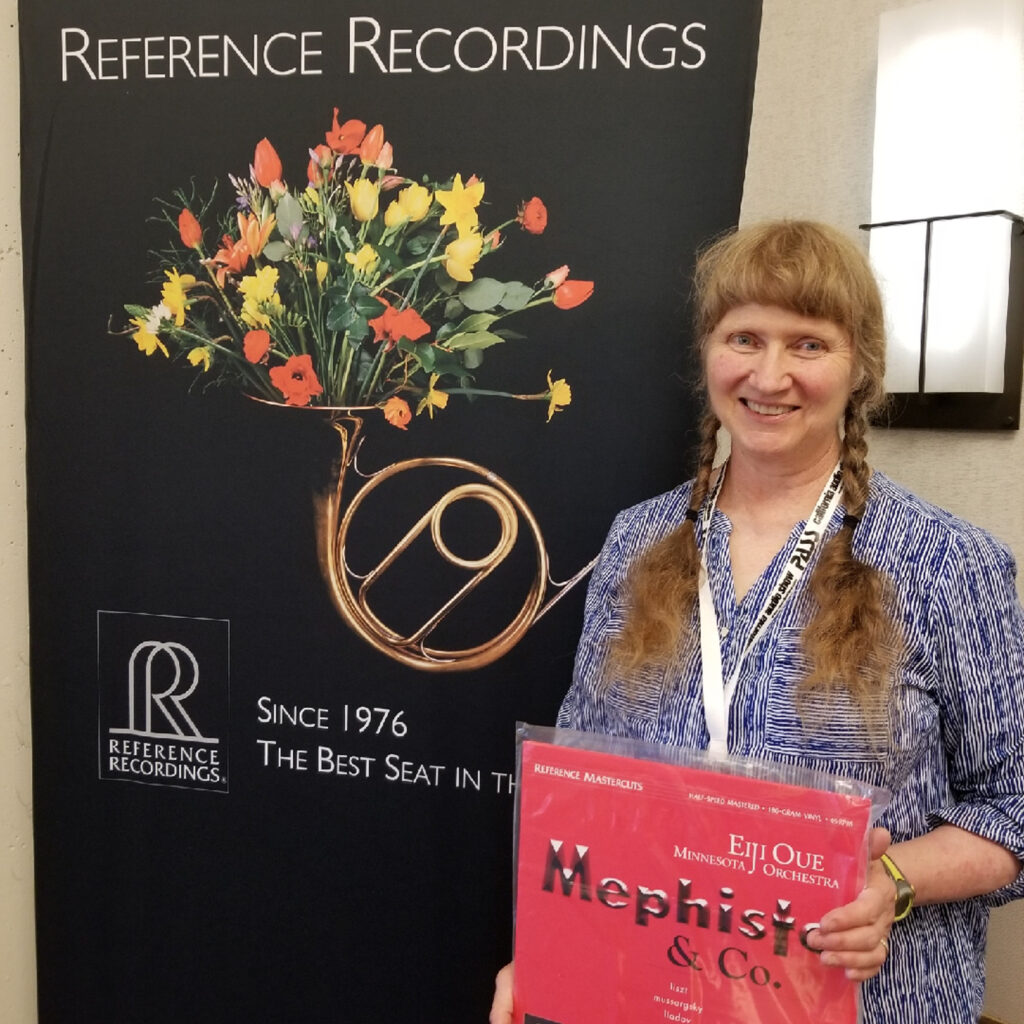
Marcia Martin joined Reference Recordings (“RR”) as a vice president in charge of business and finance back in 1980. The company had been founded four years earlier by John Tamblyn (“Tam”) Henderson, who had studied music at the University of Georgia and then worked first as Music Director for KSFR radio and subsequently as the owner of two record stores in San Francisco. Dissatisfied with the recorded sound on many classical music issuances, Henderson began to immerse himself in audiophile literature while writing reviews for Sound Advice and The Absolute Sound. Henderson wanted to produce more realistic-sounding recordings, so he teamed up with engineer Keith O. Johnson (whom Marcia Martin married in 1990). Under that leadership team, Reference Recordings grew steadily and produced an enviable catalog of classical, jazz, and blues recordings, including CDs, SACDs, 200-gram Reference Mastercuts LPs, and revolutionary HRx discs. Many of these have been critically acclaimed and/or recipients of awards.
In 2012, Marcia Martin became executive director and managing director of RR upon Henderson’s semi-retirement (he stayed on in a consulting capacity and has overseen the new Reference Mastercuts product line).
Marcia, welcome to Fanfare!
Keith, thank you! I really appreciate this opportunity to tell our story to Fanfare’s many readers.
You have been executive director for more than a decade. RR has continued to flourish, and its catalog has expanded with lots of great recordings. I know you were senior management before then, but what has it been like to run an independent, innovative record label?
When I took over as Executive Director, I became responsible for artistic decisions as well as business, legal, and finance management. It is a job full of decisions, deadlines, frustration, and joy. I am so privileged to be able to interact with many great artists and their music. I certainly do not pretend to have all the answers, however. I believe strongly in a team approach to business, and I am fortunate to have assembled and worked with an outstanding group of audio and music industry professionals at RR for many years. Some of us are family, others are longtime friends, and all are great teammates.
Do you personally have a music background?
Though I do not have an academic degree in music, I grew up in a musical family. My father, Marcus Gordon, was a concert pianist. He won a scholarship with the great pianist Josef Lhévinne in 1925. He soon began teaching at The Juilliard School, where he held a fellowship for five years. He performed innumerable concerts nationally and internationally, and also taught at universities and privately for many years. My mother, Leona Oddstad (who also performed as Leona Gordon), was an opera singer with a long career singing major roles with several U.S. opera companies. I play the lute and the piano, and during high school and college I sang in a cappella choirs. Prior to becoming part of Reference Recordings, I had been working in the high-end audio industry doing promotion and marketing and helping audio companies with their exhibits at major audio shows. From that experience I learned a lot about the best-quality recordings and audiophile playback systems.
In terms of your catalog, let me begin with the classical portfolio. I have been a fan of many of your classical recordings for quite some time, including many of the Eiji Oue/Minnesota recordings, the Nojima Liszt and Ravel recordings, Keith Clark doing Respighi’s Church Windows and other orchestral works, and a superb disc titled Last Tango Before Sunrise showcasing some fascinating music by José Serebrier. Several months ago, I was pleased to give a very positive review to your Brahms: Reimagined Orchestrations disc, which joins a number of other fine RR offerings featuring Michael Stern and the Kansas City Symphony. Also, one of my favorite opera singers was Eileen Farrell, ever since I heard her sing Brünhilde’s Immolation Scene from Götterdämmerung, and so listening to the crossover discs of her singing Rodgers & Hart, Harold Arlen, Johnny Mercer, and others has been an unalloyed delight. So, too, have been several discs by soprano Marni Nixon, singing a range of works from Copland to Gershwin to Kern.
How do you select your classical artists and repertoire, and are your state-of-the-art recordings made in a particular recording studio or at multiple locations?
During the years that Tam Henderson ran Reference Recordings, he was the producer on over 100 recordings which Keith Johnson engineered for our label, and these were considered by many to be some of the finest-sounding classical and jazz discs ever made. They were the foundation of our catalog, and almost all are still in print. Tam has a tremendous knowledge of artists and repertoire and a true gift for crafting wonderful programs for recordings. As with you, Eileen Farrell was one of his very favorite opera and crossover singers ever! He is still a great resource for me when we are deciding on artists and repertoire for new projects. For many recent projects, RR has worked with Victor Ledin and Marina A. Ledin of Encore Consultants L.L.C. in a strong collaboration to assist in signing classical artists and with repertoire decisions. RR benefits from their extensive music industry experience, including fresh ideas on production and label management.
Most of our classical albums, for both RR and FRESH!, have been and continue to be recorded in symphony halls and other concert spaces with great acoustics. We also record classical, jazz, and blues projects at Skywalker Sound in Marin County, CA, which has a fabulous and huge soundstage. Over the years, some of our jazz and blues titles have been recorded in other excellent studio spaces as well.
Wherever we record, the quality of the recorded sound is paramount. The RR Sound was originally the creation of our famed engineer and technical director Keith O. Johnson and came from his singular methods and equipment, almost all hand-built or extensively modified by him. Microphone techniques range from purist to complex, depending on the musical forces and the performing space involved. Starting in 2005, Sean Royce Martin began working as a team with Keith on RR’s recordings. They engineered and mastered many albums together through 2019. Sean is now our chief recording engineer, continuing the tradition and making new innovations of his own. Sean is also an engineer at Skywalker Sound. Keith is now 87 and has mostly stepped back from travel and long recording sessions. He still consults on recordings and is involved in our surround-sound mastering.
Starting in our early years, we developed great long-term relationships with our artists and made multiple-album series with many of the orchestras, ensembles, and solo artists who are represented on our label. Examples include the Minnesota Orchestra (19 albums), The Dallas Winds (20 albums), and the Turtle Creek Chorale (6 albums). This strategy works for us and for our customers, so we continue that tradition with our current classical artists, such as The Pittsburgh Symphony Orchestra (16 albums and more scheduled), Kansas City Symphony (9 albums and another coming in 2026), pianist Joel Fan (3 albums and one coming in 2026), and the Hermitage Piano Trio (3 albums so far). I am proud to have strategically positioned RR as one of the few American labels recording and releasing productions of top-flight American orchestras, with a special emphasis on audiophile sound and formats. We have new orchestral partnerships with releases coming soon from the Oregon Symphony, the Grand Teton Music Festival Orchestra, and the Boulder Philharmonic Orchestra.
Another classical disc I enjoyed very much featured Ruggiero Ricci performing violin concertos by Barber and Menotti. My guess—which could well be entirely unfounded—is that this performance was licensed by RR from another label. I imagine there are other such releases that have been licensed. If so, are there criteria pursuant to which you and your colleagues select which performances to license and add to RR’s catalog?
The recording you mention of Ruggiero Ricci has an interesting history! RR-45 is the only available recording of the delightful Menotti Violin Concerto in A Minor, plus Barber’s beloved Violin Concerto in G Major, op. 14. It was not licensed but was recorded in 1983 in Santa Ana, CA. The orchestra was the Pacific Symphony Orchestra conducted by Keith Clark, with whom we worked several times. An unusual arrangement at the sessions brought together two completely separate microphone/recording setups. These performances were originally released on compact disc by the label Varese Sarabande; their edition was taken from a digital master made by Bruce Leek. Our recording was engineered for RR by Keith O. Johnson and was preserved on both analog and digital masters. The Varese Sarabande title was eventually withdrawn, and RR arranged to release Keith Clark’s recording in 1992 on compact disc, and also as an LP (which is now out of print).
Regarding licensed recordings, they are issued on our “FRESH! From Reference Recordings” imprint, with the catalog number prefix “FR” instead of the “RR” prefix we use for recordings made by our own team. We are offered many projects. But we carefully choose only a select few projects to license. They must be great performances of great music, well recorded in good spaces, and with great sound. We only accept projects recorded in high-resolution digital, or possibly on analog tape.
I have only heard a few of your jazz offerings, but I was impressed with discs by Michael Garson and, of course, by Dick Hyman. Tell us about your jazz and blues portfolio and what may be in store in the coming months for our readership with particular interest in those genres.
We are extremely fortunate to have recorded and released six wonderful albums from the phenomenal jazz pianist and composer Dick Hyman, now 98 years of age. He and Tam Henderson worked closely together for many years. He is a national treasure, a 2017 NEA Jazz Master, and a longtime artistic director of important jazz festivals and series. Another “grand old man” of jazz we recorded was trumpeter Clark Terry, whose 60+ year career included performances with the big bands of Duke Ellington and Count Basie among others. He received countless GRAMMY and other awards and performed for seven presidents. One of his RR albums is still in print: RR-111: Clark Terry: The Chicago Sessions.
We are still recording new projects with Mike Garson, an amazing keyboard artist and composer. He is probably best known for his relationship with David Bowie, as his “piano man” on tours and concerts from 1971 until 2006. We have recorded and released five albums with Mike, including RR’s first big jazz hit from 1986, RR-20 Serendipity (also featuring the great Stanley Clarke on bass, with Gary Herbig, Jim Lacefield, Billy Mintz, Peter Sprague, and Jim Walker). In 2024 we recorded a new Mike Garson album at Skywalker Sound, which will be released in early 2026 and which will delight David Bowie fans as well as jazz lovers!
RR veteran Janice Mancuso, in addition to her invaluable help with RR and FRESH! promotion, works hard on signing, licensing, and producing recordings to broaden our offerings of blues, jazz, roots, and world music. She has brought RR many fine artists, including Australian blues singer/guitarist/ songwriter Fiona Boyes (four albums), the well-seasoned jazz vocalist/trumpet/harmonica player Robert Moore from Portland, jazz saxophone player Anton Schwartz (five albums), and especially the fabulous blues artist Doug MacLeod! Doug has released six albums with us and more are being planned. He is a multiple Blues Music Award winner. His latest album FR-760: Between Somewhere and Goodbye has been on the charts in the USA and UK since release in June 2025 and is a favorite on blues radio.
About 20 years ago or so, I heard a lot about High Definition Compatible Digital, an enhancement to the sonics of CDs that was developed by Keith Johnson, among others, and used in a number of RR discs. Are there second- or third-generation technologies that RR is pioneering to revolutionize further sound reproduction capabilities, particularly for large ensembles, to delight audiophiles? I’m particularly interested in learning more about HRx!
HRx was revolutionary for its time. It was the first disc format that offered very high-resolution digital WAV files (at 176.4 kHz/ 24 bits) for home playback. The format won a number of awards for innovation. Several manufacturers made machines that could play the discs. The popularity of high-resolution digital downloads and more recently high-resolution streams has made it fairly obsolete, and so we stopped making HRx discs a couple of years ago.
Similarly, HDCD was a true innovation for its time, and really improved the sound of early digital compact discs. Keith O. Johnson and Pflash Pflaumer were the inventors of the process, for their company Pacific Microsonics, Inc. Digital recordings were encoded with HDCD during the recording and mastering process using the Pacific Microsonics Model One or Model Two Encoder, and many CD players until recently included HDCD decoding capability to get the best sound from the encoded discs. Microsoft later purchased the patents and technology and still uses some of the process in Windows Media Player. We used HDCD on all our compact disc offerings until 2025. HDCD still has a small but loyal following, but unfortunately new playback machines that decode HDCD are no longer made. Software solutions that claim to decode it only do a partial job. We still make some HDCD releases, but we are phasing it out over time.
Other technologies? There always are new ideas on the horizon. And changes in the music industry offer challenges but also new frontiers. RR is doing more with immersive sound these days. Keith Johnson and Sean Martin are both working on improving our capabilities. We have offered 5.0 and 5.1 Surround Sound for many years. Now all our new RR recordings are made using microphones for height channels to allow release in Dolby Atmos/ Apple Spatial. We also hope to offer 12-channel Discrete Immersive files soon for those who have the appropriate playback systems.
What can you tell us about your “FRESH!” series?
In 2010 we started our “FRESH! From Reference Recordings” imprint. An increasingly important part of our label, now with 62 releases, our FRESH! series showcases outstanding artists and recordings made by engineering teams outside the original RR team. Quality is paramount at our label, and RR often gives input prior to recording and during editing, post-production, and/or mastering phases. We are extremely pleased to release compact discs and high-quality, hybrid multi-channel SACDs, and soon LPs as well, on this series with some of the best American orchestras and other groups. Many FRESH titles are recorded and mastered in DSD by the team at Soundmirror, whose outstanding orchestral, solo, opera, and chamber recordings have received over 140 GRAMMY nominations and awards.
Finally, as RR approaches its 50th anniversary, are there any exciting new artists, ensembles, or other expansions to your business that you might be able to preview for us?
For our 50th anniversary, we are working on a great lineup of releases. But we do indeed have exciting changes coming to RR operations soon. We moved to larger premises recently, so for the first time we have room for more than just warehouse space and offices.
We now have a dedicated space for our own LP cutting studio, and have just installed the specially modified half-speed cutting lathe and electronics we used in previous years to create Reference Mastercuts LP titles. This equipment was in storage for some years but is now operating again and being tested. New titles never released on LP before are planned by 2026. The first ones will be drawn from our award-winning Pittsburgh Symphony Orchestra series and from our other new orchestral partnerships. And there will be more LP titles released from Keith Johnson’s legacy recordings, and new titles from Mike Garson and Doug MacLeod!
By the beginning of 2026, we will be done with construction of a soundproof audio control room/editing suite with audio, video, and Dolby Atmos mastering capability. We have also created and are refining a small recital/recording space. We plan to use this space for jazz, classical chamber and solo, and acoustic blues recordings.